
If you have been told you have bone loss and you are wondering whether implants are still possible, the answer for most people is yes. But the path to getting there varies considerably depending on how much bone has been lost, where, and what is causing it. At Dentistry At Its Finest in Costa Mesa, patients exploring options to Replace multiple teeth with implants often ask whether bone loss rules out treatment. In many cases, it does not, but the plan may need to include bone preservation or grafting to create a stable foundation.
Bone loss is the most common reason patients get referred elsewhere or told they need additional work before implants can even be discussed. That news feels discouraging. The reality is that bone grafting has become a routine part of implant dentistry, and the outcomes for grafted sites are nearly as good as placements in native bone.
Most patients who come in asking about implants despite bone loss are adults between 40 and 75 who lost teeth years ago and are now ready to address it. Tooth loss triggers bone resorption. The longer that gap has been sitting there, the more jawbone has quietly disappeared. At Dentistry At Its Finest in Costa Mesa, CA, patients regularly arrive having been told elsewhere that implants were not an option. In many of those cases, they are. They just need a different treatment plan. Women tend to come in earlier. Men often arrive after the bone loss has progressed further, which sometimes means more preparation is required before anything can be placed.
What Does Bone Loss Actually Mean for Implant Candidacy?
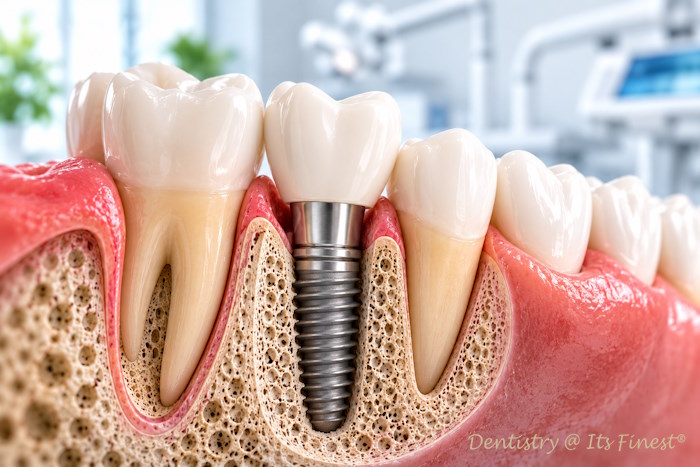
An implant is a titanium post that has to fuse with the surrounding jawbone. That fusion process, called osseointegration, is what makes an implant stable and long-lasting. For osseointegration to work, there needs to be enough bone height, width, and density at the implant site.
When a tooth is lost, the alveolar bone that supported it starts to resorb. This begins within weeks. It continues for months to years, and it does not stop on its own. Periodontal disease accelerates the process, destroying bone around teeth before they are even lost. Patients who had gum disease for years before extractions often have significantly less bone volume than someone who lost a tooth to trauma.
A standard implant requires roughly 10 to 12mm of bone height and about 6mm of ridge width at minimum. When measurements fall below those thresholds, placement without augmentation either is not possible or produces a compromised long-term result. That is the clinical reality, and it is why a cone-beam CT scan at the consultation is not optional.
“Bone loss does not automatically close the door on implants. It just means we have more to plan for. Some patients need a small localized graft. Others need more extensive augmentation. But the first step is understanding exactly how much bone you have, where, and what we can predictably do about it.” — Dr. Michael Ayzin DDS
How Much Bone Loss Is Too Much for Dental Implants?
There is no single cutoff number. It depends on where the loss has occurred, what condition the remaining bone is in, and which augmentation procedures make sense for that specific situation.
Mild bone loss, under about 25% reduction in ridge volume, often allows implant placement with minimal extra work. A socket preservation graft placed at the time of extraction, or a small localized graft before placement, is frequently all that is needed.
Moderate bone loss in the 25 to 50% range typically means bone grafting before or simultaneously with placement. In the upper jaw, the maxillary sinus often sits very close to the ridge after tooth loss, leaving limited vertical bone for back teeth. A sinus lift addresses this directly. Both the lateral window approach and the less invasive crestal technique have long track records for predictable outcomes.
Severe loss above 50% is genuinely more complex. But even here, options exist. Zygomatic implants anchor into the cheekbone rather than the jaw and can work for patients with very limited upper jaw bone who are not candidates for conventional implants even after grafting. In the lower jaw, nerve repositioning or shorter implant designs sometimes solve problems that standard-length fixtures cannot.
Completely impossible is rarer than most patients expect.
What Procedures Make Implants Possible Despite Significant Bone Loss?
Bone Grafting Before or Alongside Implant Placement
Bone grafting is the most common solution. Graft material, whether autogenous bone from the patient, processed donor bone, bovine xenograft, or synthetic substitutes, is placed into the deficient area. Over several months, the patient’s own bone grows into and replaces the graft material, producing a denser ridge that can support an implant.
The outcomes data on grafted implant sites is reassuring. A large-scale analysis of 158,824 implants found that simultaneous bone augmentation produced a clinical success rate of 97.83%, statistically comparable to placements in native bone. A separate long-term study of 10,158 implants across 3,095 patients found that augmented sites had a slightly higher survival rate of 96.3%, compared to 94.3% for implants without augmentation. The graft adds time. It does not meaningfully reduce the long-term odds of success.
Sinus Lift for Upper Back Teeth With Limited Bone Height
The maxillary sinus descends after posterior tooth loss, leaving very little vertical bone for implants in the upper back of the mouth. A sinus lift elevates the sinus floor and creates room for graft material. It is one of the most studied procedures in implant dentistry and adds a few months to the overall timeline but opens the door to placement for a large number of patients who would otherwise not qualify.
Ridge Expansion for Narrow Ridges
When the ridge has reasonable height but not enough width, expansion techniques mechanically widen the bone to create space for the implant. This is often done at the same time as placement, reducing the number of separate procedures.
Shorter Implant Designs for Limited Bone Volume
Short implants, typically 6mm or under, and narrow diameter implants are designed for situations where standard fixtures are not appropriate. They are not ideal for every case, but they significantly expand who can benefit from treatment without requiring major augmentation.
When Are Implants Not a Realistic Option and What Comes Next?
A small percentage of patients genuinely cannot proceed with implants, even with augmentation. Uncontrolled systemic disease, active cancer treatment involving radiation to the jaw, severe uncontrolled diabetes, and complete loss of the alveolar ridge in a region are situations where implants may not be achievable.
For these patients, implant-retained overdentures often offer a meaningful alternative. As few as two implants in the lower jaw can anchor a removable denture and dramatically improve its stability and function compared to a conventional denture sitting on the gum. This option remains feasible even with more significant bone loss because implants are placed where bone still exists.
Traditional bridges and well-fitted removable prostheses are also legitimate choices for patients who cannot pursue implants or who decide grafting is not the right path for them.
| Bone Loss Level | Typical Implant Options |
|---|---|
| Mild (under 25%) | Standard implant, possibly with minor graft |
| Moderate (25 to 50%) | Bone graft or sinus lift before or with placement |
| Severe (over 50%) | Extensive augmentation, zygomatic implants, or overdentures |
| Complete ridge loss | Implant-retained overdenture or conventional prosthesis |
What Patients Have Said About Their Experience at Our Practice
“Dear Doctor Ayzin, thank you so much for the amazing work you did for me in the reconstruction of my teeth. It was awesome! Now I can eat and my teeth look beautiful! I cannot thank you enough. Dr. Ayzin, you have a formidable office team! You are extremely knowledgeable and the best in your profession and I truly believe that you are an artist. I thank you from the bottom of my heart. The three implants done at the same time were awesome. Dentistry at Its Finest is highly recommended!”
— Franklin Jacks
“Excellent place. Been going since around 2013. Done all my normal cleanings there along with some veneers and a tooth extraction and implant. Great staff, family run.”
— J. Hughes
“Smiling faces. Great customer service. The friendliest dentists I’ve ever met. Not to mention that the procedure was near painless, and it was an implant!”
— Joe Gold Kim
Want to Know Whether Bone Loss Rules Out Implants in Your Case?
A cone-beam CT scan at your consultation is what gives a real answer. It shows the actual volume, height, and density of bone at each potential implant site and lets your dentist give you specific information rather than a general estimate.
Dentistry At Its Finest sees patients from Santa Ana, Fountain Valley, and Newport Beach, along with the surrounding Costa Mesa area. Michael Ayzin DDS will review your imaging, give you an honest read on your bone situation, and walk through what a realistic treatment timeline looks like.
Call (949) 239-0020 or visit us to book a consultation.
What Patients Should Know About Implant Coverage Before Treatment Begins | How Night Guards Prevent Broken Teeth in People Who Grind Their Teeth
