
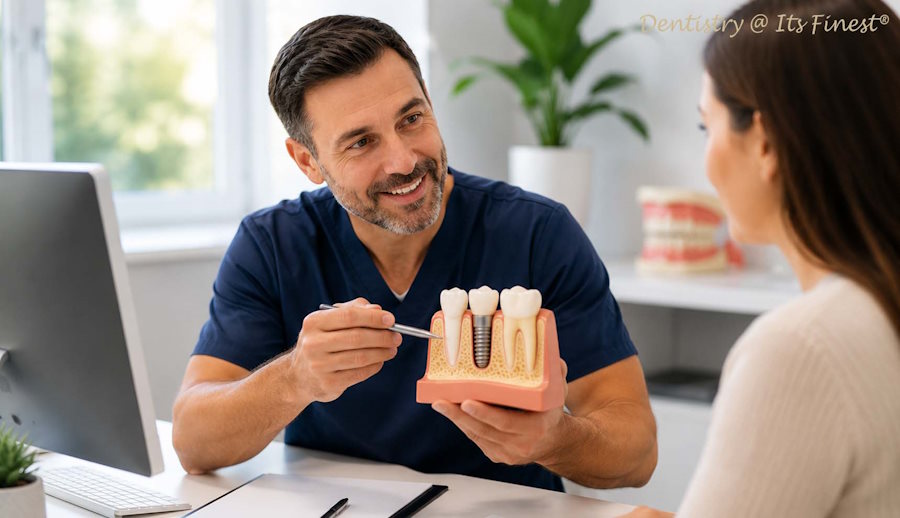
You get the treatment plan. You see the number. And your first thought is, okay, I have dental insurance, so how much of this is it actually going to cover?
For most people, the answer is less than they expected. Sometimes a lot less.
That’s not a cynical take. It’s just how dental insurance is structured, and understanding that structure before you start calling your carrier saves a lot of frustration. At Dentistry At Its Finest in Costa Mesa, we believe patients should feel confident and informed before starting implant treatment. If you’re planning to replace missing teeth, our team will help you understand coverage options, costs, and what to expect so you can make the best decision for your smile.
Why Dental Insurance and Implants Don’t Get Along
Dental insurance was designed in an era when the biggest restorative procedures were crowns and dentures. The framework hasn’t changed much. You get preventive care covered at or near 100%, basic restorative work like fillings covered at around 80%, and major procedures covered at 50%. Implants, if they’re covered at all, land in that major category.
Here’s where it falls apart. Most plans cap annual benefits somewhere between $1,000 and $2,000. A single implant, post, abutment, and crown combined typically runs $3,500 to $5,000. So even if your plan genuinely covers implants at 50%, you might hit your annual ceiling after collecting $900 in actual reimbursement. The math just doesn’t work in your favor.
A 2020 survey from the National Association of Dental Plans found that fewer than half of employer-sponsored dental plans included any implant benefit at all. Half. And among those that do, the coverage frequently applies only to certain components. The porcelain crown on top might be covered. The titanium implant post that goes into the bone, the part that makes an implant an implant, often isn’t.
The missing tooth clause is something a lot of people don’t find out about until it’s too late. Many plans simply won’t cover the replacement of a tooth that was already gone when the policy started. Lost a molar two years ago and just now looking for coverage? That clause may eliminate your benefit for that tooth, even if implants are otherwise listed as a covered procedure in your plan documents.
What Actually Covers Implants
Some plans do cover them meaningfully. High-tier PPO plans from Delta Dental Premier, certain Cigna tiers, and some Aetna and Humana plans include real implant benefits. Not comprehensive, but real.
Dental HMO plans, also called DHMO or capitation plans, sometimes include implants depending on the specific plan. The catch is a narrower provider network and a fixed copay structure rather than percentage reimbursement. Whether that works out in your favor depends entirely on the plan’s fee schedule.
If you’re over 65 in California, standard Medicare won’t touch dental. Denti-Cal covers extractions and dentures, full stop. Some Medicare Advantage plans have dental riders that include implants, but you have to read the actual plan document to find out. The summary brochure won’t tell you.
Dental savings plans are worth knowing about separately. They’re not insured. They’re membership arrangements where you pay an annual fee in exchange for negotiated rates on procedures, including implants. No reimbursements, no annual caps, no waiting periods. For a patient whose regular coverage excludes implants entirely, a savings plan might reduce the procedure cost by several hundred dollars or more, depending on the arrangement.
Before your consultation, it’s worth confirming which plans are accepted at the practice. That way you can get a rough cost picture that already accounts for your specific coverage.
“The patients who actually get something useful out of their coverage are the ones who pick up the phone and ask their carrier specific questions before they sign up for a plan. Not whether implants are covered in general. Whether their specific tooth, the one that’s already missing, is covered. Because that missing tooth clause changes everything.” – Michael Ayzin DDS
What These Plans Actually Pay in Practice
The percentages look better than the reality. Here’s what tends to happen:
A standard PPO with a $1,500 annual maximum that covers implants at 50% after a $100 deductible will pay out somewhere around $700 on a $4,500 procedure. That’s it. The rest is yours.
A higher-tier plan with a $3,000 annual maximum does better, but on a $4,500 implant you’re still looking at $1,500 or less in reimbursement after hitting the ceiling, and that’s before factoring in whether you’ve used any of that annual benefit on other dental work during the year.
Dental savings plans don’t reimburse anything but reduce your fee directly. A negotiated rate that takes $600 or $800 off the procedure cost isn’t nothing, especially when your PPO isn’t covering the post.
How To Actually Figure Out What You Have
Call your carrier. Don’t rely on the summary plan description. Ask whether implants are covered, whether the post, abutment, and crown are billed as separate line items or a bundled benefit, whether there’s a missing tooth clause, and whether it applies to the specific tooth you need replaced, and whether there’s a waiting period before major restorative benefits kick in.
Then ask your dental office to submit a predetermination of benefits before anything is scheduled. This is a formal written request to your insurer asking them to confirm in writing what they’ll pay toward the proposed treatment. It’s not a guarantee, but it gives you a documented number before money changes hands. It also has a way of clarifying very quickly whether the coverage you thought you had is the coverage you actually have.
Sorting It Out Before You Commit
Patients come to us from Irvine, Newport Beach, Laguna Hills, Mission Viejo, and across the area with a folder full of insurance questions before they’re ready to move forward. We help them figure out what their plan covers, submit predetermination requests, and build a realistic cost picture before anything gets scheduled.
Call (949) 239-0020 or visit Dentistry At Its Finest to talk through your situation with Michael Ayzin DDS.
