
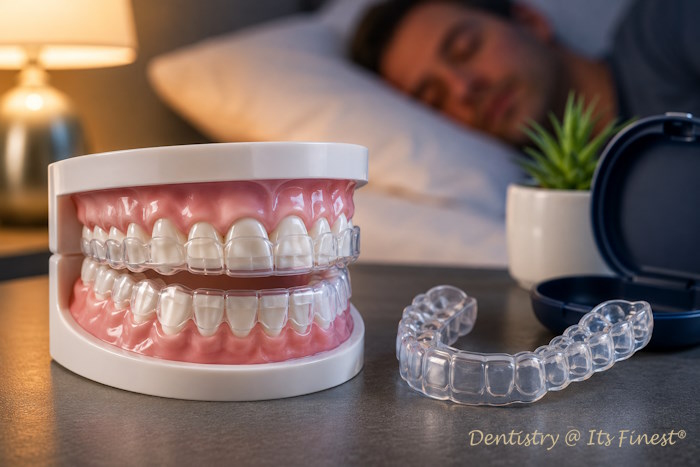
If you grind your teeth at night and have been told to wear a night guard but never really understood why, this article will make it click. Once you understand the actual force involved in bruxism and what it does to enamel over time, the decision to protect your teeth stops feeling optional. At Dentistry At Its Finest in Costa Mesa, knowing what to do when you break a tooth starts with understanding how nightly grinding can silently weaken enamel until a small chip turns into a bigger fracture. A custom night guard acts as a buffer, absorbing the force of clenching and grinding so your teeth don’t take the full impact.
Bruxism, the involuntary grinding or clenching of teeth during sleep, affects somewhere between 8% and 31% of adults, with the most commonly cited estimate around 20% of the US population. Most people who grind have no idea they are doing it. They wake up with jaw soreness, morning headaches, or sensitivity and do not connect any of it to what happened while they were asleep.
At Dentistry At Its Finest in Costa Mesa, CA, patients coming in for night guard consultations are typically adults between 25 and 55. Women and men are affected at similar rates, though women with TMJ-related symptoms tend to seek care a little earlier. Most patients arrive after a dentist spots worn enamel at a routine exam, after a filling cracks, or after a partner mentions they can hear the grinding from across the room.
Why Does Teeth Grinding Generate Enough Force to Break Teeth?
Normal chewing produces bite forces of around 150 to 200 pounds per square inch. Bruxism is different. The jaw muscles involved in grinding can push past 250 pounds per square inch, and because the grinding happens repeatedly throughout the night with no food to absorb any of the impact, those forces land directly on the enamel surface for hours.
Enamel handles compressive forces reasonably well. What it does not handle well is sustained lateral shear force, the side-to-side grinding motion that bruxism creates, applied to the same spots night after night. That specific mechanical condition is what initiates the microcracks, flattening, and eventual fractures that show up years down the road.
Teeth with existing restorations are especially vulnerable. A tooth with a large composite filling or an old amalgam has already had its enamel structurally compromised. The filling and surrounding enamel expand and contract at different rates and bond imperfectly over time. Under the cyclical loading of grinding, the enamel around a restoration cracks faster than it would in a healthy, intact tooth.
“Patients come in with a broken cusp and assume it just happened. When I look at the tooth, I can see the wear pattern from grinding that has been building for years. The fracture was not sudden. It was the endpoint of a long process. The night guard is what interrupts that process before the endpoint arrives.” — Dr. Michael Ayzin DDS
How Does a Night Guard Absorb and Redirect the Forces of Bruxism?
A night guard works by putting a layer of engineered material between the upper and lower dental arches. When the jaw muscles activate during sleep, that force does not land directly tooth-on-tooth. It transfers through the guard material first.
The guard absorbs some force through material compression. It also spreads the remaining force more evenly across the entire arch rather than concentrating it at specific contact points. And it changes the mechanical angle of the load. The guard’s flat occlusal surface prevents the lateral shear motion that does the most enamel damage and redirects force into a more vertical, compressive direction that teeth are far better equipped to handle.
Do Hard Night Guards Protect Better Than Soft Night Guards?
Soft night guards are made from flexible thermoplastic. They are comfortable, easy to get used to, and fine for mild grinders. The problem for heavy grinders is that the flexible material can actually encourage more clenching. The jaw muscles have something to bite into, so they bite harder. Patients with severe bruxism sometimes wake up feeling worse with a soft guard than without one.
Hard acrylic night guards, also called occlusal splints, are made from rigid heat-cured acrylic. They do not compress under bite force. The hard surface lets the jaw slide freely during grinding without generating the reactive muscle force that softer materials can trigger. For moderate to severe bruxism, a hard guard is the better protective tool.
Dual-laminate guards have a hard outer shell with a softer inner layer and sit between the two options in terms of both comfort and protection. A properly fitted guard starts with a custom mouthguard fitting rather than a boil-and-bite version. It’s worth comparing that upfront cost to what a new crown runs if a cusp fractures instead.
The most important variable in any guard is fit. An over-the-counter boil-and-bite guard costs around $30 and provides some protection. A custom-fabricated guard made from dental impressions, with the occlusal surface adjusted to your actual bite, distributes forces more evenly and is far less likely to cause jaw fatigue or TMJ strain from an uneven contact pattern.
What Types of Tooth Damage Does a Night Guard Prevent Most Effectively?
Enamel Wear That Cannot Be Reversed
The most visible long-term damage from grinding is attrition, the gradual flattening and thinning of biting surfaces. Once enamel is worn away, it does not grow back. The dentin underneath is exposed, sensitivity increases, and the structural protection of the tooth is permanently reduced. Enamel loss from bruxism is irreversible, and a night guard is the only thing that stops it from accumulating.
Cusp Fractures and Cracked Tooth Syndrome
Repeated cyclical loading initiates microcracks in the enamel that deepen slowly over time. When a crack reaches a critical depth, a cusp fractures. Sometimes it is a clean break that can be crowned. Sometimes the crack runs vertically into the root, making the tooth unrestorable. A night guard does not eliminate all fracture risk, but it dramatically reduces the sustained lateral loading that starts and propagates those cracks in the first place.
Broken Fillings and Crown Failure
Composite resin fillings, ceramic inlays, and porcelain crowns are all susceptible to fracture under bruxism forces. Patients who grind without protection consistently replace restorations faster than patients who wear guards. Each replacement requires removing more tooth structure than the one before it, which compounds over time.
TMJ Strain and Jaw Muscle Fatigue
Night guards do not stop the jaw muscles from activating during sleep. But they reduce the forces transmitted to the joints and muscles by changing the mechanical relationship between the arches. Many patients notice less jaw soreness and fewer morning headaches within the first few weeks of consistent wear.
Why Getting a Night Guard Before a Tooth Breaks Is Always the Smarter Choice
A custom night guard from a dental office runs roughly $300 to $700 depending on the design. A single crown to repair a broken cusp typically costs $1,200 to $2,000. A cracked tooth that needs extraction and implant replacement runs $3,000 to $5,000 or more.
The night guard is the least expensive option by a wide margin, and it is the only one that prevents damage rather than repairing it after the fact. Every restoration placed in a grinding patient without a guard is at elevated risk of failure. And some outcomes of untreated bruxism cannot be undone at any price. Enamel worn away is gone. A tooth with a vertical root fracture is typically unrestorable. Getting a guard now means those outcomes stay off the table.
What Our Patients Are Saying
“I hate dentists. So much I have avoided going for far too long. I needed 25k in work done and they are the first to help me navigate this mess. I had 4 crowns and 2 veneers done with my current budget and I’m halfway through now. I’ve been living with broken teeth for 15 years. My smile is beautiful now. The energy in this office is beautiful. The entire staff is amazing. And I couldn’t possibly recommend them more online.”
— Craig Allison
“I had a great experience today at this office. I was a first time patient and needed two impacted wisdom teeth and a broken tooth extracted. I felt welcomed immediately from the lovely front desk woman Joyce and assistants were very kind and straightforward and helpful with giving me information and payment options. Dr. Ayzin did a consultation and was able to take me within the hour to do my extractions. Not only was the whole process painless, but they were all very fast and so kind to me. I will definitely be back for all my dental needs.”
— Haley Brees
Do Your Teeth Show Signs of Grinding?
The best time to get a night guard is before you lose a cusp. If you grind or clench, the wear pattern is already building. Getting evaluated now costs far less than waiting until a tooth fractures.
Dentistry At Its Finest sees patients from Huntington Beach, Monticello Community, and College Park, along with the surrounding Costa Mesa area. Michael Ayzin DDS will look at the wear on your teeth, assess how severe the grinding is, and recommend the right type of guard for your situation.
Call (949) 239-0020 or visit us to book a consultation.
