
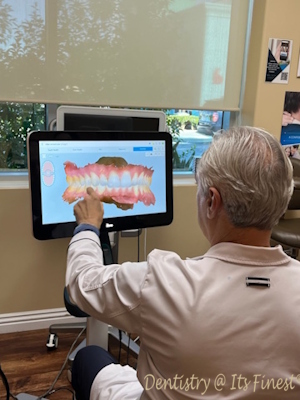
Most people know dentures replace missing teeth. Fewer people know that over time, they change the shape of your face. Not in a dramatic, sudden way, but gradually, year by year, in ways that become harder to ignore the longer you wear them. At Dentistry At Its Finest in Costa Mesa, patients can learn more about complete dentures and how they may influence facial support over time. Understanding these changes early can help you maintain a more natural look and a comfortable fit.
Patients at Dentistry At Its Finest in Costa Mesa bring this up in two situations. Either they’re a few years into wearing dentures and starting to notice something looks different in the mirror, or they’re researching before committing to dentures and want the full picture before they decide. Both are exactly the right time to understand this.
Who Tends to Notice Facial Changes From Full Dentures?
This mostly affects adults in their 50s through 70s who’ve been wearing full dentures for several years, though how fast changes appear depends heavily on individual bone density and overall health. The American College of Prosthodontists estimates that more than 36 million Americans have no remaining natural teeth, with a large portion relying on conventional removable dentures.
At Dentistry At Its Finest, the patients who come in most concerned about this tend to be women in their 60s who’ve had dentures for five or more years and have started noticing shifts in their jaw line, lip support, or chin position. Men experience the same bone loss but tend to show up later, usually after the denture fit has become noticeably worse. Both groups do better when they understand the process early.
Why Do Full Dentures Change the Face at All?
The short answer is bone. Your jaw contains alveolar bone, the ridge that exists specifically to anchor your teeth. When teeth are in place, every bite and chew sends mechanical force down through the roots into that bone, which signals the body to keep it dense and tall. Pull the teeth out and that signal disappears.
Dentures rest on top of the gum tissue. They don’t reach the bone, they don’t stimulate it, and the body gradually reabsorbs it because there’s no longer a structural reason to maintain it. This process is called resorption and it continues regardless of how well your dentures fit.
“Patients sometimes assume that wearing dentures prevents the bone loss that comes with tooth loss. The denture maintains function and appearance in the short term, but the underlying bone keeps changing. That’s the part of the journey most people aren’t prepared for, and it’s why monitoring matters so much over the years.” — Dr. Michael Ayzin DDS
How Does Jawbone Resorption Change the Way You Look?
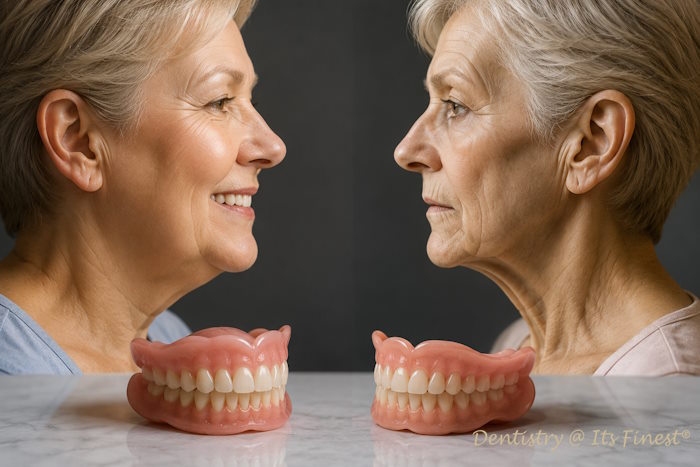
Bone loss doesn’t just shrink the jaw ridge in isolation. It shifts the spatial relationships between your upper jaw, lower jaw, chin, lips, and cheeks in ways that compound over time.
Research published in the Journal of Prosthetic Dentistry found that the residual alveolar ridge loses roughly 0.5mm to 1mm of bone per year in the early years after extraction, with the lower jaw resorbing at up to four times the rate of the upper jaw. That gap between upper and lower resorption rates is what drives a lot of the visible facial changes.
The lower third of the face shortens as the jaw ridge flattens. Lip support drops as the bone and tissue behind the upper lip recede. The chin starts to rotate forward and upward relative to the nose, which is sometimes described as a “witch’s chin” appearance. Cheeks hollow out as the underlying bony framework contracts. Soft tissue folds and jowling become more prominent because the skeleton underneath is no longer holding things up the same way.
None of this happens fast. It builds across years, which actually gives you windows to intervene.
How Do These Facial Changes Progress Year by Year?
Understanding roughly when things happen helps you know when to check in rather than just waiting until something feels obviously wrong.
| Timeframe | What’s Happening | What You Might Notice |
|---|---|---|
| First 6 months | Rapid initial resorption post-extraction | Dentures feel looser, minor fit changes |
| Year 1 to 3 | Continued bone and tissue loss | Changes in lip fullness, denture stability decreasing |
| Year 3 to 5 | Slower but cumulative resorption | Facial shortening, chin position shifting |
| Year 5 and beyond | Significant ridge loss in many patients | Marked appearance changes, retention becomes harder |
Bone loss is fastest immediately after extraction. That first year is the most critical checkpoint, which is why some dentists recommend waiting a few months before making a permanent denture so the ridge has a chance to stabilize. Immediate dentures placed the same day as extractions almost always need relining more frequently during that window.
What Can Actually Slow or Prevent Denture-Related Facial Changes?
This is where things get more encouraging. There are legitimate options that change how this plays out.
Do Dental Implants Actually Protect the Jawbone?
Dental implants are titanium posts placed directly into the jawbone. They function like artificial tooth roots, transmitting bite force back into the bone the same way natural teeth do. That mechanical stimulation tells the body to maintain the bone rather than resorb it. Even two to four implants supporting a removable overdenture, a denture that snaps onto implant attachments, can significantly slow alveolar bone loss compared to a conventional full denture sitting on the gum surface.
This isn’t a cosmetic upgrade. It’s a fundamentally different biological situation for your jaw and what happens to it over time.
Even a removable option built around implant-anchored dentures changes the bone-loss picture significantly. It’s worth budgeting for the switch early rather than waiting until fit becomes a problem.
Does Denture Fit Actually Make a Difference to Bone Loss?
A well-fitting denture spreads bite pressure more evenly across the ridge. A loose one concentrates pressure in specific spots, which accelerates uneven bone loss and distorts facial appearance faster than it needs to. Getting dentures relined every one to two years, or sooner when they start feeling loose, is one of the most straightforward things you can do to stay ahead of this between appointments.
How Does Your Overall Bone Health Connect to This?
Systemic factors matter here too. Calcium intake, vitamin D levels, and baseline bone density all affect how quickly resorption progresses. Patients with osteopenia or osteoporosis tend to see faster ridge loss. Coordinating with your physician on bone health alongside your dental care is a step that doesn’t get talked about enough, but it makes a real difference across the years.
What Are Patients Saying About Their Experience?
“I am so grateful and blessed that I found Dentistry At Its Finest. I was tired of wearing uncomfortable and ill fitting dentures. I made an appointment and the process began that 1st visit. It was an incredible journey, one that was so rewarding and worth it. I love my new teeth and smile. The entire staff were so encouraging and an absolute pleasure to work with. I felt so comfortable in their care. Professional and genuine. If you’re looking for implants I give them a 10 and highly recommend them.”
— Joyce
“My first visit far exceeded my expectations. I had not been to a dentist in at least a decade and bright and cheery it was compared to the old days. I got a deep cleaning and a temporary bridge for a missing tooth on my first visit. I’m 100% happy about the whole experience. The dentist and staff were great.”
— Bernard Shick
If you’re in Halecrest, Downtown Costa Mesa, or Huntington Beach and starting to notice changes in how your face looks with dentures, that conversation is worth having sooner rather than later. Our team at Dentistry At Its Finest can assess where you are in this process and help you figure out what makes sense next. Call (949) 239-0020 to schedule a consultation.
