
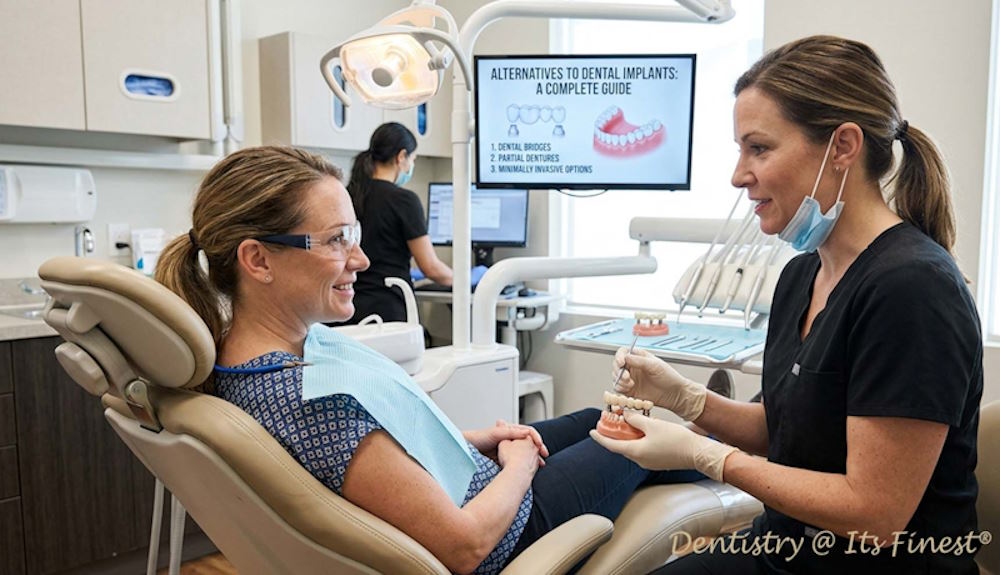
Tooth loss is not a rare problem. It happens to people of all ages, for all kinds of reasons, and the moment it does, the questions start piling up fast. Can I afford implants? Do I even qualify? Is there something else that works just as well? If you are somewhere in that process right now, this guide is meant to give you real answers, not a sales pitch. Single Dental implant placement is one of the most commonly discussed solutions when replacing a missing tooth.
Patients who walk into our Costa Mesa office have usually already done some research before the first appointment. They have seen the implant pricing online, maybe read a horror story or two, and they want to know what their actual options are. At Dentistry At Its Finest, we think that conversation should happen before any treatment decision gets made, not after.
“Every patient deserves to understand every viable option before committing to a treatment plan. Informed consent is not just a legal requirement. It is the foundation of great dental care.” — Michael Ayzin DDS
Why People Look for Alternatives
Let us be direct about something. Implants are excellent. When someone is a good candidate and can manage the cost and timeline, an implant is hard to beat. It behaves like a real tooth, it keeps the jawbone healthy, and it can last the rest of your life if you take care of it.
But a lot of people are not in that position, and that is just reality.
Some patients come in with significant bone loss at the extraction site, which means grafting would be required before an implant is even placed. That adds months to the process and several thousand dollars to the bill. Others have health conditions like uncontrolled diabetes or are on medications that affect how bone heals, which changes the risk profile of surgery entirely. Smokers face higher implant failure rates. And for plenty of people, the cost alone is the deciding factor. A single implant can run $3,000 to $5,000 or more, and most insurance plans treat that number as your problem, not theirs.
According to the American College of Prosthodontists, around 120 million Americans are missing at least one tooth, and over 36 million have none left at all. That is a massive number of people navigating this exact decision, many of them without clear guidance on what their choices actually are.
All Available Options Compared
There are several well-established ways to replace a missing tooth that do not involve implant surgery. Each has a real clinical track record. None of them is second-rate by definition, they are just different tools for different situations.
Removable Partial Dentures
A removable partial denture replaces one or more missing teeth with a framework that clips onto the remaining natural teeth. Patients take it out to clean it. It is the most affordable option on this list, typically somewhere between $300 and $1,800, and it can usually be ready faster than other restorations.
The honest downside is that it does not stop bone loss in the area where the tooth is missing. Over time, without a root stimulating the bone, that ridge shrinks. Some patients also find the adjustment period uncomfortable, particularly with chewing and speech. For someone who needs a functional, affordable solution now while figuring out a longer-term plan, though, it is a reasonable starting point.
Full Dentures
When every tooth in an arch is gone, a full denture restores the appearance of a complete smile and brings back basic chewing ability. It sits on the gum tissue and depends on the shape of the underlying ridge for stability, which tends to get less reliable as years pass and bone continues to resorb.
One option that bridges the gap between full dentures and implants is the implant-retained overdenture. Two to four implants are placed to anchor the denture in position. It is still removable, but it stays put in a way that a conventional denture never quite does. For patients who want the improved function without the full cost of a fixed implant bridge, it is worth a serious conversation.
Fixed Dental Bridges
A fixed bridge is cemented in permanently. It replaces a missing tooth by crowning the teeth on either side and suspending an artificial tooth between them. You brush and floss it like normal teeth. There is no removing it at night.
| Feature | Fixed Bridge | Dental Implant |
| Surgery Required | No | Yes |
| Bone Preservation | No | Yes |
| Typical Lifespan | 10 to 15 years | 20+ years |
| Estimated Cost | $1,000 to $3,000 | $3,000 to $5,000 |
| Adjacent Teeth Affected | Yes | No |
The catch is that the two teeth on either side have to be filed down to support the crowns, even if those teeth are otherwise healthy. That is a real tradeoff. If those neighboring teeth already need crowns for other reasons, the math changes. But if they are perfectly healthy teeth, you are permanently altering them to fix a different problem.
Resin-Bonded Bridges
Also called a Maryland bridge, this is a more conservative version of the fixed bridge. Instead of full crowns, small wings bond to the backs of the adjacent teeth with minimal drilling. It works best for replacing a single front tooth, and it is particularly common for younger patients where preserving natural tooth structure is a bigger priority. It is not the right choice for every gap, but when it fits the situation, it is a smart option.
Flipper Appliances
A flipper is a temporary removable appliance that fills a gap after an extraction while a permanent solution is being planned or made. It is inexpensive, lightweight, and not designed to last years. Think of it as a placeholder that keeps aesthetics intact while the actual work gets sorted out.
How to Choose the Right One for Your Situation
There is no universal ranking where one option is always best and another is always second. The right choice depends entirely on your specific clinical picture. How many teeth are missing and where? What shape are the neighboring teeth in? How much bone is left at the site? What does your medical history look like?
Good decision-making here starts with a proper examination, including X-rays that show what is actually happening below the gumline. For anything involving potential surgery, a cone beam CT scan gives a three-dimensional picture of bone volume that a flat X-ray simply cannot provide. Patients in Costa Mesa and nearby can call (949) 239-0020 to set up that evaluation.
When Implants Are Still the Best Choice
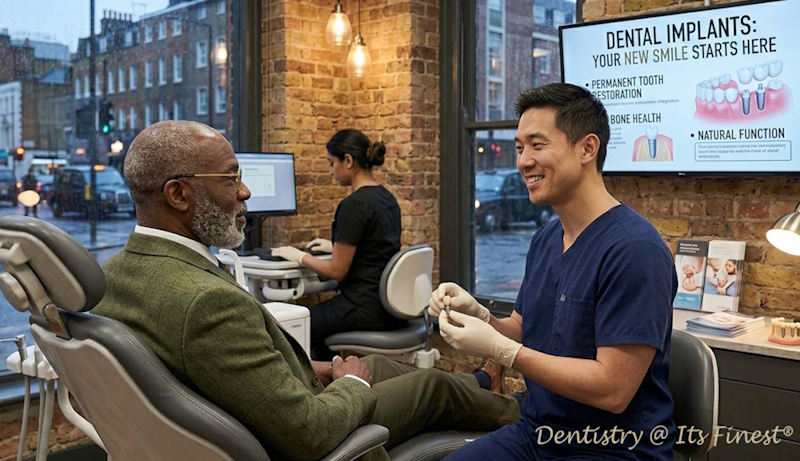
None of what has been written above is meant to talk anyone out of implants. For patients who qualify, implants remain the most biomechanically sound option available. They are the only restoration that stimulates the alveolar bone the way a natural root does, which is what prevents the gradual bone loss that follows every other type of tooth replacement. The clinical literature on long-term outcomes backs this up consistently.
The point is simply that qualifying matters. A well-matched alternative for a patient who does not qualify for implants will outperform an implant placed in poor bone with inadequate healing conditions every single time. Matching the solution to the patient is the job.
“I’ve been a long-time customer of Dentistry At Its Finest and for good reason! Time and time again, they deliver top-quality service and products. A lot of people don’t like the dentist, but really what they don’t like is feeling.” – Jordan Gaarenstroom
“I had an urgent dental problem and was looking for a good dentist for same-day treatment. And this place was the only one giving a fast response and an appointment. That was the start of my dental treatment with Dr. Ayzin.” – Wen Yang
Talking Through Your Options in Costa Mesa
If you are weighing these choices and want a straightforward conversation about what actually makes sense for your mouth, not a generic recommendation, Michael Ayzin DDS and the team at Dentistry At Its Finest are here for that. Patients come to us from Newport Beach, Irvine, Huntington Beach, Santa Ana, and across Costa Mesa. We will look at your X-rays, talk through your health history, and give you a real picture of what your options are and what each one actually involves. Call (949) 239-0020 to schedule a consultation.
