
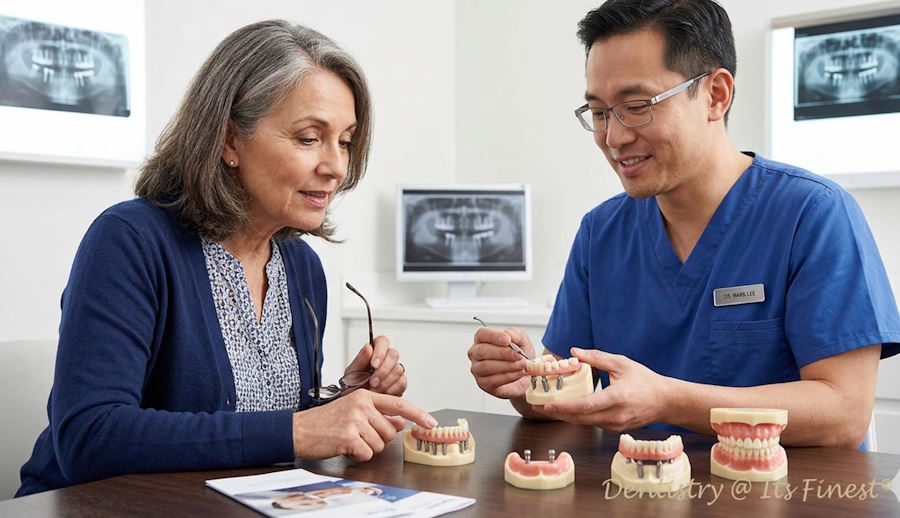
Most patients who come in asking about full arch implants have already spent hours on Google. They’ve seen All-on-4 ads, maybe watched a few before-and-after videos, and they’re still not sure what they actually need. The honest answer is: it depends, and anyone who gives you a number before looking at a CBCT scan is guessing. For those searching for dental implants in Costa Mesa, the answer always starts with a careful assessment.
Patients coming to us in Costa Mesa, CA, from places like Newport Beach, Irvine, and Huntington Beach usually arrive with the same core question. At Dentistry At Its Finest, we do a full diagnostic workup before we ever talk numbers, because the implant count isn’t a package deal. It’s a clinical decision.
The Range: 4 to 8 Per Arch
For a single arch, the realistic range is 4 to 8 implants. That’s not a hedge. Those numbers reflect genuinely different clinical scenarios, and the right count for one patient can be completely wrong for another.
The three protocols you’ll hear about most are All-on-4, All-on-6, and All-on-8. They’re not just marketing tiers. Each one reflects a different approach to how the load gets distributed across the jaw.
All-on-4 is the most established. Four implants per arch, with the two in the back placed at an angle, usually around 45 degrees, to get purchase on denser bone and sidestep the need for grafting in a lot of cases. A clinical review in the International Journal of Oral and Maxillofacial Implants put the 5-year cumulative survival rate above 94%, which is solid. It works well, especially for patients with some bone loss who want to avoid a longer, more involved surgical process.
All-on-6 spreads the load across two more implants. Better distribution, more redundancy. For patients with decent bone volume or stronger bite forces, it’s often the more sensible choice even if it costs a bit more upfront.
All-on-8 is less common. It’s used when the bone is genuinely abundant, and the prosthetic demands are high, or when a clinician wants maximum support for a heavier restoration.
| Protocol | Implants Per Arch | When It Makes Sense |
| All-on-4 | 4 | Bone loss present, avoiding grafts |
| All-on-6 | 6 | Good bone volume, higher bite load |
| All-on-8 | 8 | Optimal bone, maximum prosthetic support |
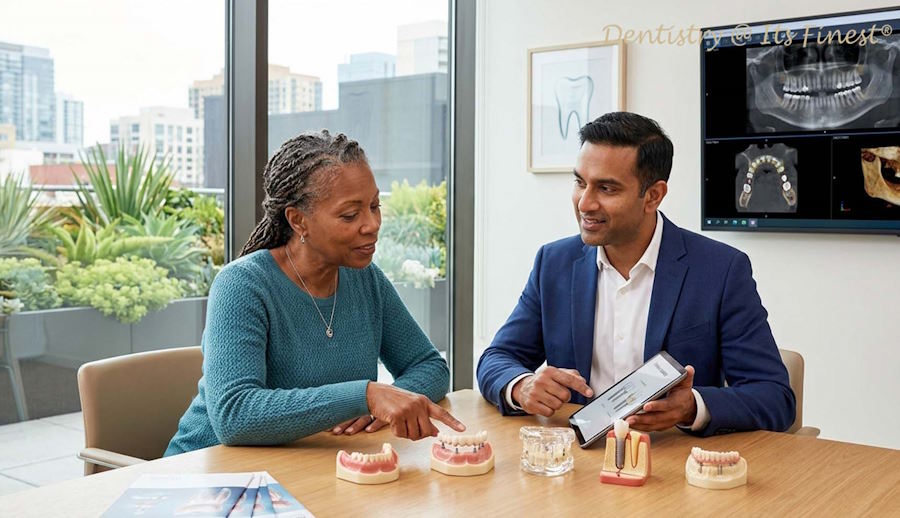
What Actually Drives the Decision
Bone density and volume are the starting point. The back of the upper jaw sits close to the maxillary sinuses, and the bone there tends to be softer and less predictable. That’s why upper arch cases frequently call for more implants than lower arch cases, where the mandible is denser, and osseointegration happens more reliably.
Systemic health matters too. Uncontrolled diabetes, osteoporosis, and long-term bisphosphonate use, these things affect how well bone fuses to an implant surface. When there’s a higher biological risk, some clinicians will recommend adding implants as a buffer.
The prosthesis design feeds back into the implant count as well. A screw-retained zirconia bridge puts different mechanical stress on the implants compared to an acrylic hybrid. The restoration and the implant plan have to match each other, and that requires the restorative dentist and the surgeon to actually be on the same page before anyone picks up a drill.
“The number of implants we place is never a default setting. It comes from the imaging, the bone quality, the prosthetic plan, and what’s genuinely going to hold up for that specific patient over time.” – Michael Ayzin DDS
Upper vs Lower: Not the Same Jaw
This distinction doesn’t get enough attention. The lower jaw is generally denser. Four implants can provide excellent anchorage for a full arch prosthesis. The upper jaw is a different situation. Between lower bone density and the sinus anatomy, six implants are a more common recommendation for the maxilla, even when four would be adequate below. It’s not a rule carved in stone, but it reflects what clinicians actually see in practice.
For full mouth cases, both arches, you’re typically looking at somewhere between 8 and 16 implants total. The planning phase for that kind of case is substantial. Bite registration, provisional restorations, and sequencing the surgery correctly, it all feeds into the outcome. Patients who skip past the diagnostic work tend to run into more problems downstream.
Where to Go From Here
If you’re in the Costa Mesa area and trying to figure out whether you’re a candidate for full arch implants, the first step is imaging, not a quote. A CBCT scan shows what the bone actually looks like, and that’s what drives every number after it.
“Loved the interaction with intake staff who were attentive, warm, welcoming, personable, thorough, informative, took time with me, and were very responsive to my questions about the implant process.” – Dr. Saundra Taulbee
“I’ve had nothing but good experiences with the whole unit. I hate to mention names cause I’m scared I might miss someone. And that would be unfair. I’m in the process of getting full implants so far I’ve had teeth pulled and implants.” – Jim LAWSON JR
Dentistry At Its Finest serves patients exploring full arch restoration from East Side Costa Mesa, Westside Costa Mesa, and Fountain Valley who are ready to take the next step toward a complete, lasting smile. Every treatment plan starts with a thorough diagnostic workup so you get a recommendation based on your actual bone structure, not a one-size-fits-all number. Call us today at (949) 239-0020 to schedule your consultation with Dr. Michael Ayzin.
Give us a call at (949) 239-0020 or visit https://www.finestdentistry.com/ to set up a consultation. We see patients from across Orange County, and we’ll give you a straight answer based on what your jaw actually shows, not a brochure answer.
