
Your dentist just recommended a crown after your root canal. You want to know if that recommendation is actually necessary or if there are situations where it can reasonably be skipped. At Dentistry At Its Finest in Costa Mesa, Dentistry At Its Finest dental crown services are often recommended after root canal therapy to protect a tooth that has been weakened by decay or infection. For patients considering a root canal, it helps to understand when a crown is essential and when alternatives may be appropriate.
Most of the time, a crown is the right call. But not always, and the reasoning matters more than the blanket recommendation. Understanding what the root canal actually does to the tooth structurally is what makes everything else click into place.
People asking this question are usually adults between 30 and 60 who just finished endodontic treatment on a back molar or premolar and are now weighing the next step before committing to another appointment and another cost. At Dentistry At Its Finest in Costa Mesa, CA, patients come in after having root canals done here or elsewhere wanting a clear answer about whether the crown step is genuinely required for their specific tooth, not just a general policy.
Why Do Dentists Recommend a Crown After Most Root Canals?
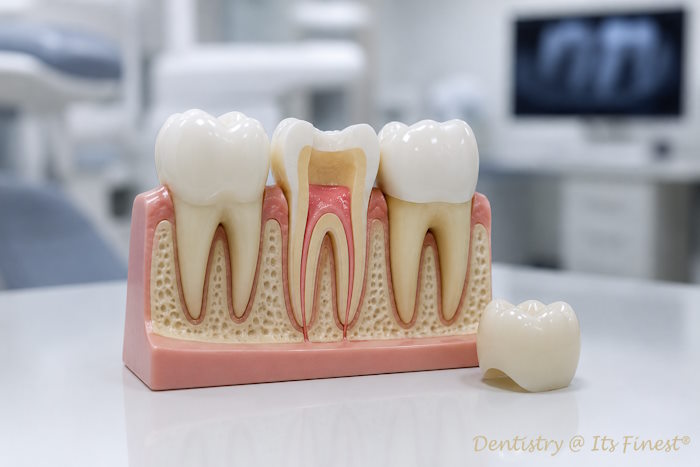
The root canal procedure removes the pulp from inside the tooth, the soft tissue bundle containing the nerves and blood supply. Once that tissue is gone, the tooth stops receiving the internal moisture and nutrients that kept the dentin resilient. The tooth does not hurt anymore, which patients often interpret as a sign that everything is fine. The structural reality is different. A tooth without vital pulp becomes progressively more brittle over time, and back teeth absorb a lot of force.
The access preparation, the opening drilled through the crown to reach the canals, removes additional tooth structure on top of whatever was already lost to the cavity that caused the infection. A molar that came in with a large filling, developed decay underneath it, and then had a root canal done through it may be left with very little solid tooth structure holding things together. That tooth needs to be protected.
A study published in the Journal of Endodontics by Aquilino and Caplan found that root canaled teeth without crowns were six times more likely to be lost than those restored with a crown. Six times. That number holds up consistently across the research literature.
“Completing a root canal without placing a crown on a back tooth is like rebuilding an engine and not putting the hood back on. The work inside was done correctly, but the tooth is unprotected. The crown is what makes the whole investment worthwhile.” — Michael Ayzin DDS
What Is the Crown Actually Doing for the Tooth?
A crown covers the entire visible portion of the tooth above the gumline and distributes biting forces across the whole surface rather than concentrating them on weakened cusps. It also seals the access opening. That sealing function matters more than most patients realize. Bacterial recontamination of the canals through a leaking temporary or a poorly restored access site is one of the most common reasons root canals fail over time. The crown closes that pathway.
When Might a Crown Not Be Immediately Necessary?
There are exceptions, but they are specific.
Front teeth are the clearest case. Upper and lower incisors and canines are used for biting and tearing, not the heavy grinding load that molars absorb. The access preparation for a front tooth is also simpler and removes less structure. If a front tooth comes through the root canal with adequate remaining tooth structure, no existing cracks, and the patient does not have a heavy bite or bruxism history, a well-bonded composite restoration can sometimes be appropriate without an immediate crown. This is genuinely case-by-case.
Some premolars with minimal pre-existing decay and a small, uncomplicated access preparation fall into a similar monitoring category, though that requires careful evaluation and follow-up X-rays to confirm the tooth is holding up.
The variables that actually matter are how much tooth structure remains, where the tooth sits in the arch, whether there are any cracks, and what the patient’s occlusal forces look like day to day. A dentist who has examined the tooth and reviewed the X-rays can give a real answer. A general policy cannot.
What Are the Risks of Skipping a Crown After Root Canal Treatment?
A root canaled molar without a crown is at real risk of fracturing under normal chewing. Sometimes the fracture is a manageable cusp chip that can be repaired. More often it is a vertical root fracture that runs down into the bone, and vertical root fractures are almost always unrestorable. The tooth comes out. The patient has paid for a root canal they can no longer save and is now looking at an implant or bridge to fill the space.
The temporary filling material placed after a root canal is not designed to function long-term. It wears, it develops microleakage around the margins, and bacteria can recontaminate the canals, sometimes silently, before any symptoms develop. By the time the patient feels something is wrong, the infection at the root apex has often already re-established.
People who have gone through the root canal have already done the hard part. Skipping the crown is the most common way an otherwise successful procedure ends up failing.
What Should You Ask Your Dentist Before Making a Decision?
If you are on the fence, a few specific questions will get you further than a general conversation about whether crowns are always necessary.
How much natural tooth structure is left after the root canal? A tooth that had most of its crown intact going in is in a fundamentally different situation than one that had a large pre-existing cavity and lost substantial structure during the access preparation.
Are there any existing cracks in the tooth? If there are, the crown is not optional. It bands the tooth circumferentially and stops cracks from propagating further under biting forces.
What does your bite look like and do you grind at night? Bruxism patients put significantly more occlusal force on their teeth during sleep than during normal chewing. That changes the risk calculation considerably for a root canaled tooth sitting without crown protection.
How long has the temporary been in place? If it has been more than a few weeks, getting the permanent restoration placed becomes more pressing.
| Tooth and Situation | Crown Typically Needed? |
|---|---|
| Molar with large access opening | Yes |
| Premolar with significant pre-existing decay | Yes |
| Front incisor, small access, solid structure | Sometimes not immediately |
| Any tooth with existing cracks | Yes |
| Any root canaled tooth in a bruxism patient | Yes |
| Front tooth with minimal remaining structure | Yes |
What Patients Have Said About Their Experience Here
“All of my expectations were exceeded at Dentistry at its Finest. Dr. Ron Ayzin possesses great skill and great kindness in equal measure. I knew I could put all my trust in his assessment of my condition and subsequent work. He also worked very closely with their excellent lab to ensure that I was 100% happy with the results. I have very hard to match teeth due to childhood tetracycline use, and as it also involved my highly visible top front teeth, I was very concerned as to whether crowns could duplicate my own teeth in appearance. Final result: they blend PERFECTLY — not to mention the beautiful shape and seamless alignment. A caring and dedicated staff complete the experience.”
— Reatha Klemme
“I’ve been a long-time customer of Dentistry At Its Finest and for good reason! Time and time again, they deliver top-quality service and products. A lot of people don’t like the dentist, but really what they don’t like is feeling.”
— Jordan Gaarenstroom
Not Sure Whether Your Tooth Needs a Crown?
If you have recently had a root canal and want a clear answer about whether a crown makes sense for your specific situation, a clinical assessment is the only reliable way to find out.
Dentistry At Its Finest sees patients from Newport Beach, Irvine, and Santa Ana, along with the surrounding Costa Mesa area. Michael Ayzin DDS will look at the actual tooth, review the X-rays, and give you a straight answer about what it needs and why.
Call (949) 239-0020 or visit us to book a consultation.
Quick Steps To Protect Your Tooth After a Lost Crown | How Full Dentures Affect Your Facial Structure Over Time
