
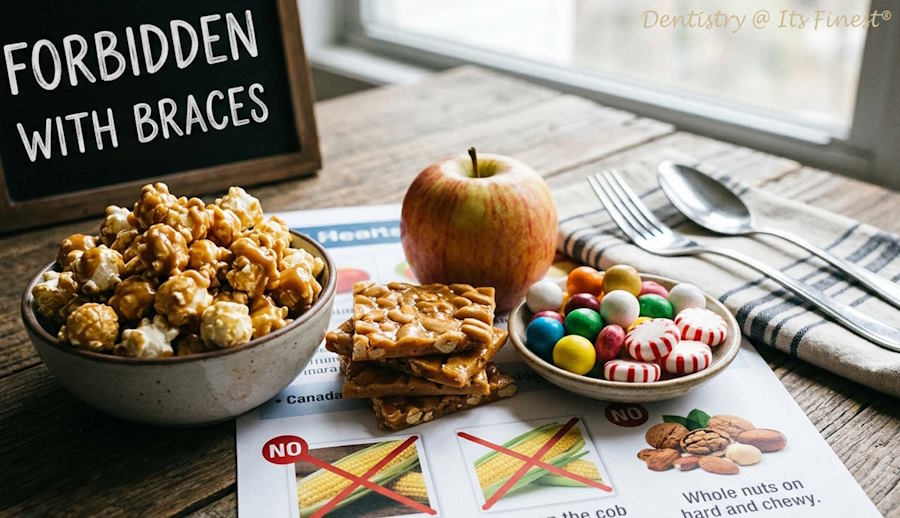
Nobody enjoys this conversation, but it’s one of the most important ones that happens at the start of orthodontic treatment. The food restrictions with metal braces aren’t arbitrary. They exist because the mechanical system moving your teeth is more fragile than it looks, and breaking it repeatedly makes treatment take longer and cost more. Orthodontic braces treatment works best when patients avoid foods that can damage the appliances or make oral hygiene more difficult.
Curious what a full course of treatment can achieve? You can see real results from real patients. Dentistry At Its Finest in Costa Mesa, CA goes through this at every braces consultation. The patients who finish on time are almost always the ones who took it seriously early.

What’s Actually at Risk When You Eat the Wrong Things
Metal braces are a system. Brackets bonded to each tooth, an archwire threaded through each bracket slot, and elastic ligatures holding the wire in place. The brackets are bonded with dental adhesive that handles normal biting forces fine. It doesn’t handle the leverage and impact that hard or sticky foods create.
When a bracket debonds, that tooth stops moving. The orthodontic mechanics are only working on teeth with intact bracket bonding. A bracket that’s been off for two weeks means that the tooth didn’t move for two weeks, and in a year-and-a-half treatment plan, that adds up. Patients who break brackets frequently don’t just have inconvenient extra appointments. They have longer treatment overall.
Archwire distortion is the second mechanical problem. A wire bent by biting into something hard delivers unpredictable forces to the teeth, sometimes moving them in directions the treatment plan didn’t intend. Correcting that can mean reversing progress.
Research published in the European Journal of Orthodontics found that non-compliant patients experience up to twice the bracket debonding rate of compliant patients. That’s not a marginal difference.
The Foods That Are Actually Off-Limits
Hard foods that require biting directly are the main offenders. Whole apples, raw carrots eaten stick-style, corn on the cob, hard pretzels, crusty baguettes. The force generated when you bite into something hard goes directly to the bracket face and levers it off the tooth surface. This is the most common way brackets break, and it’s entirely preventable.
Popcorn gets its own mention because patients underestimate it. The fluffy pieces seem harmless. The unpopped kernels that are always in the bowl are dense enough to crack a bracket on contact. There’s no version of eating popcorn with braces that reliably avoids the hard pieces.
Ice is another one people don’t think of as eating. It is. Chewing ice is one of the more reliable ways to damage brackets, and it’s a habit that tends to happen mindlessly.
Sticky and chewy foods work differently. They don’t shatter or create point pressure. They pull. Caramel, taffy, gummy candy, fruit snacks, gummy vitamins, and dried fruit all deform during chewing and create adhesive force against the bracket surface as they move through the mouth. Chewing gum displaces elastic ligatures, the small colored elastics holding the wire in the bracket slot, more consistently than almost anything else. Sugar-free versions do the same thing.
“Broken brackets aren’t just an inconvenience. They’re a setback. When a bracket comes off, that tooth stops moving until the patient gets back in and we repair it. Multiply that across multiple brackets over a year of treatment, and you’re looking at real additional time.” Sona Bekmezian DDS
The sugar piece matters beyond mechanics. Brackets and wires create additional surfaces where plaque accumulates, and cleaning becomes harder. The American Association of Orthodontists identifies white spot lesions, areas of enamel demineralization from prolonged acid exposure, as one of the most common complications of orthodontic treatment. They appear around bracket margins in patients with high sugar intake and inconsistent brushing, and they’re permanent marks on enamel that remain after the braces come off.
The Foods That Catch People Off Guard
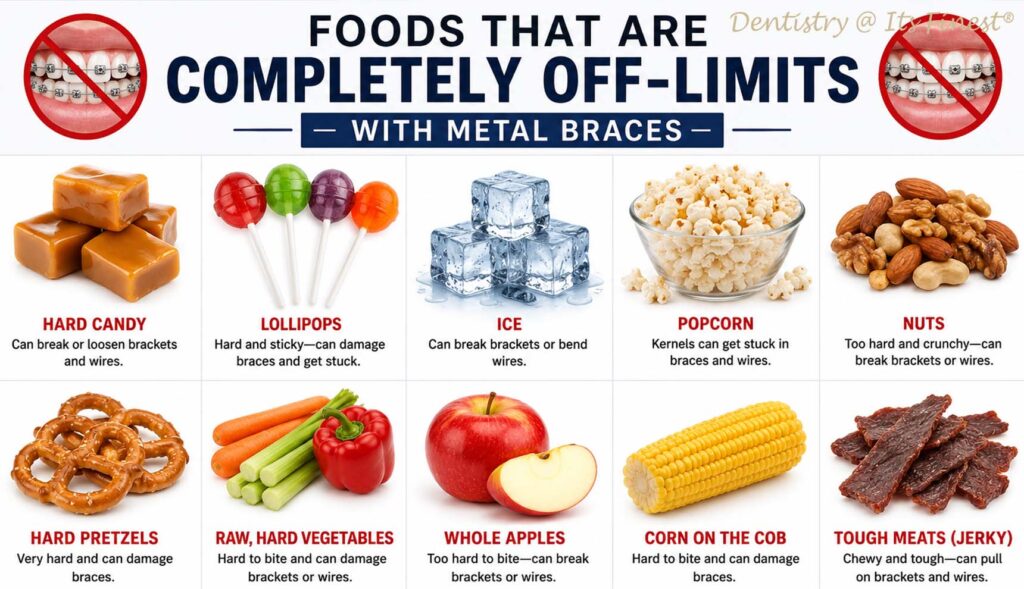
These feel safe but aren’t.
Bagels have a dense, chewy pull that creates real tension on the brackets during tearing. The pizza crust at the edge is too hard. Hard taco shells shatter. Tortilla chips and potato chips seem soft but create enough point pressure during biting to debond brackets. Chunky peanut butter has hard fragments. These aren’t obvious offenders, which is why they’re responsible for a disproportionate number of bracket failures in patients who think they’re following the rules. Hard or sticky foods carry a real risk of a cracked bracket, which can set treatment back.
| Category | Examples | Why It’s a Problem |
| Hard biting foods | Whole apples, raw carrots, corn on cob, hard pretzels | Lever force directly on bracket face |
| Crunchy foods | Popcorn, ice, taco shells, hard chips | Shattering pressure damages brackets and wires |
| Sticky and chewy | Caramel, gummy candy, taffy, chewing gum | Pulls at brackets, displaces ligatures |
| Dense chewy foods | Bagels, pizza crust, crusty bread | Tearing tension debonds brackets |
| High-sugar items | Sodas, candy, sweet drinks | Accelerates enamel demineralization at bracket margins |
What You Can Actually Eat
The list above is longer than patients expect, but it doesn’t mean the next year and a half will be miserable. Most restrictions are about preparation, not the permanent elimination of food categories.
Apples and carrots are genuinely fine, cut into small pieces and chewed with the back teeth. Corn is fine off the cob. Crusty bread works without the hard outer crust. Most hard foods become safe when you remove the direct anterior bite force from the equation by cutting things into smaller pieces before they go in your mouth.
Unrestricted foods include pasta, rice, eggs, soft-cooked vegetables, most fruits, yogurt, cheese, soft fish, cooked chicken cut into pieces, bananas, berries, and oatmeal. In the first few days after an adjustment when pressure sensitivity peaks, smoothies, mashed potatoes, and soup are genuinely practical choices that require almost no chewing at all.
Getting Started With Braces in Costa Mesa
“Great experience with braces! Staff is very friendly and helpful. Dentistry @ its finest made the process so easy!” – Hailey Prieto
“I found Dentistry @ it’s finest through Instagram with them having a summer special on braces. I reached out and am happy I did. They do it all! I was so pleased with my consult, cleaning and getting set up with braces. Best cleaning I’ve ever had. Love my braces and the whole process. The staff is very friendly and welcoming.” – Melissa Heavrin
Sona Bekmezian DDS and the team at Dentistry At Its Finest treat patients through the full course of metal braces treatment and revisit the dietary guidance at appointments rather than just once at the start. Call (949) 239-0020 if you have questions about starting treatment or about managing something that’s already come up during treatment.
Dr. Sona Bekmezian and the orthodontic team at Dentistry At Its Finest proudly serve metal braces patients from Monticello Community, Downtown Costa Mesa, and Santa Ana who are committed to protecting their smile throughout treatment. Following the right diet is one of the simplest ways to stay on track and finish on time. Have questions about your braces or ready to get started? Call us at (949) 239-0020 today.
