
There is a gap in your smile and you want it gone. A simple enough goal. But the moment you start researching treatment options, you run into a wall of conflicting information. Some sources say Invisalign handles gaps easily, others say braces are the only reliable way to close them for good. Both can be true, depending entirely on the specifics of your case. At Dentistry At Its Finest in Costa Mesa, patients looking for a virtually invisible way to fix a crooked smile can explore whether Invisalign or braces is the better fit for closing gaps. The right choice depends on the size of the space, how your teeth and bite are aligned, and how much control your treatment needs.
Most people searching this topic are adults who have been living with a diastema, that interdental space between teeth, for years. Some have a single gap between their two front teeth. Others have spacing scattered across several teeth. The treatment that works best for one of those situations is not necessarily right for the other.
At Dentistry At Its Finest in Costa Mesa, CA, the patients who come in asking about gap closure are mostly between 25 and 55. Adults currently make up the largest segment of Invisalign users, accounting for 64.3% of the market in 2024. Women tend to start that conversation a little earlier than men, often around a specific life event. Men usually come in after something prompts them to finally act on something they have been thinking about for a while. What brings people in varies. What they all want is the same thing: a closed gap that stays closed.
How Invisalign and Braces Each Approach Gap Closure Mechanically
These are not two versions of the same tool. They move teeth through completely different force systems, and that difference is exactly what makes one better suited than the other for certain types of gaps.
How Invisalign Closes a Gap
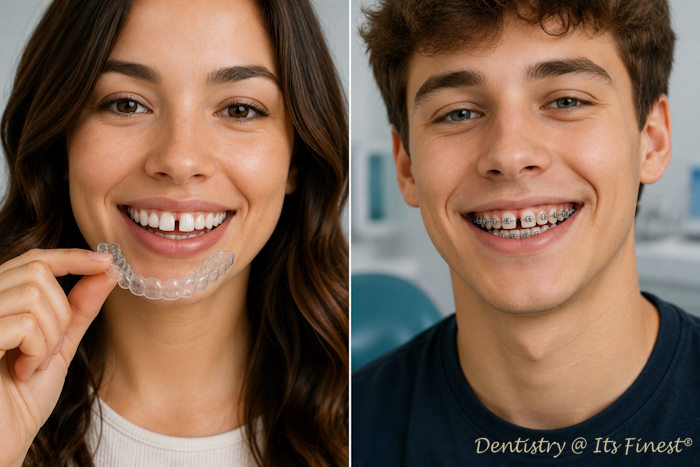
Invisalign works through a series of custom polyurethane aligner trays. Each tray is slightly different from the last, and the sequence is mapped out digitally through Align Technology’s ClinCheck software before treatment even starts. You change trays every one to two weeks, and each one moves targeted teeth by fractions of a millimeter in a planned direction.
For gap closure, the aligner applies mesial force to the teeth on either side of the space, nudging them toward each other over time. This approach works well when the gap is under about 2 to 3 millimeters and there is no major bite correction happening at the same time. A single midline gap between the upper central incisors is honestly one of Invisalign’s stronger use cases. The movement is controlled, the digital planning lets the orthodontist anticipate how each stage will unfold, and refinement trays can fine-tune the result toward the end of treatment.
The treatment success rate for mild to moderate misalignments with Invisalign sits at roughly 80 to 90%. That is a solid number, but it assumes the case actually fits within Invisalign’s clinical range and that the patient wears the trays 20 to 22 hours a day. Compliance is not optional. It is the whole thing.
How Traditional Braces Close a Gap
Traditional braces bond brackets directly to each tooth and thread a continuous archwire through them. When the orthodontist tightens or replaces that wire at each appointment, the tension translates into tooth movement. For gap closure specifically, power chains — elastic modules that link brackets together — generate sustained mesial force across multiple teeth at once.
That continuous arch tension is what makes braces particularly effective for wider or more complex spacing. The orthodontist has direct, hands-on control over force direction and magnitude at every visit. They can add coil springs to open space where needed, or close it more aggressively where the gap is wider. It is a more adjustable system during active treatment, which matters when the situation is not straightforward.
Understanding how brackets and wires work together explains why braces handle wider spacing so reliably. It also helps to know why that gap formed in the first place, since the cause affects the fix.
When Is Invisalign the Better Choice for Closing Gaps Between Teeth?
The honest answer is that Invisalign earns its place in gap closure when the clinical picture fits within a specific window.
A single anterior diastema under 2 millimeters, healthy bone and gum tissue, no bite correction needed alongside the spacing — that is a strong Invisalign candidate. Add in an adult patient who understands the compliance requirements and the treatment tends to move along efficiently. The aesthetic appeal is a real factor too. Patients in professional settings or those who simply do not want a visible appliance for 18 to 24 months find the removable, clear tray system genuinely easier to live with.
“Invisalign is a precision instrument. When the case fits within its range, it can close gaps beautifully and efficiently. The key word is when. A thorough records appointment tells us exactly whether Invisalign is going to work brilliantly for your gap or whether braces will get you to a better finish line faster.” — Dr. Sona Bekmezian
Where Invisalign can run into trouble is when patients underestimate the wear requirement. Taking the trays out for a few extra hours each day does not just slow progress. It can introduce unpredictable tooth movement. The teeth follow whatever force they experience, and if the trays are out, that force disappears. The gap does not necessarily open back up overnight, but the treatment plan starts drifting from what was originally mapped out.
When Do Braces Deliver Better Results for Tooth Gap Closure?
Some gaps need more than a tray system can reliably provide.
A midline diastema wider than 3 millimeters often involves the labial frenum, the small tissue attachment between the upper lip and the gum tissue between the front teeth. When that frenum is pulling the central incisors apart, closure requires either a frenectomy before or during treatment, or very deliberate force management that braces handle with more precision at that scale. Aligners can struggle to maintain torque control on the roots during wide gap closure, which affects long-term stability.
Braces are also clearly the stronger choice when spacing is not just anterior. Posterior gaps, gaps distributed across several teeth, or gaps that exist alongside a significant overbite, crossbite, or rotational correction all favor the bracket-and-wire system. The continuous archwire coordinates the whole arch simultaneously in a way that sequential aligners are not designed to do.
Ceramic braces address most of the aesthetic concerns. They are not invisible, but they are considerably less noticeable than metal brackets, and many adults in their 30s and 40s choose them specifically because they want braces-level control without the full metal look.
How Do You Choose Based on Your Teeth Gap Size and Case Complexity?
Here is a practical starting point before your consultation:
| Gap Situation | Likely Better Option |
|---|---|
| Single midline gap under 2mm, healthy bite | Invisalign |
| Multiple small gaps across front teeth | Invisalign with planned refinements |
| Diastema over 3mm with frenum involvement | Braces |
| Spacing plus overbite or crossbite to correct | Braces |
| Posterior spacing across back teeth | Braces |
| Patient with realistic compliance concerns | Braces |
This table is a starting point, not a diagnosis. Root angulation, bone density, whether adjacent teeth have had restorations, and the health of the alveolar ridge all factor into which system produces the most stable result. A gap that closes and reopens because the mechanics were not right the first time is not a win. Stability matters as much as closure.
The records appointment, which includes digital photographs, a panoramic radiograph, and a 3D scan or impressions, is what turns a general sense of your options into a specific, reliable treatment plan. That appointment is where your real journey starts.
What Patients at Our Practice Have Said
“Really good customer service. Everyone is nice, patient, and flexible. I’m super glad I decided to go with this office for my Invisalign treatment. They took care of my needs and I’m getting great results. Definitely recommend!”
— Emily H
“I found Dentistry At Its Finest through Instagram with them having a summer special on braces. I reached out and am happy I did. They do it all! I was so pleased with my consult, cleaning and getting set up with braces. Best cleaning I’ve ever had. Love my braces and the whole process. The staff is very friendly and welcoming.”
— Melissa Heavrin
Not Sure Yet Which Treatment Is Right for Your Tooth Gap?
If you have been going back and forth on this, the clearest next step is getting a proper evaluation. Reading about gap closure only takes you so far. Seeing the actual radiographs and 3D scan is what settles the question.
Dentistry At Its Finest sees patients from Monticello Community, College Park, and Mesa Del Mar, along with the surrounding Costa Mesa area. Orthodontist Dr. Sona Bekmezian will look at your specific gap, your bite, your bone, and give you a straight answer about which treatment is actually going to work and why. No guesswork, just a clear plan built around your specific situation.
Call (949) 239-0020 or visit us to book your consultation.
