
Your dentist has given you a choice, and now you’re trying to figure out which option actually makes sense. A bridge or a partial denture. Both replace missing teeth. Both have legitimate reasons to choose them. But they work in completely different ways, and the wrong choice for your situation can mean years of unnecessary hassle or expense. At Dentistry At Its Finest in Costa Mesa, CA, patients can explore options like Dentistry At Its Finest dental bridge services or learn more about partial dentures to find the right fit for their needs. Each solution offers unique benefits depending on your oral health, lifestyle, and long-term goals.
At Dentistry At Its Finest in Costa Mesa, CA, Michael Ayzin DDS has this conversation with patients regularly. What works well for one person’s mouth is the wrong call for someone else’s. This article walks through both options honestly so you can come to your next appointment with a real sense of what you’re deciding between.
What a Dental Bridge Is and How It Replaces Missing Teeth
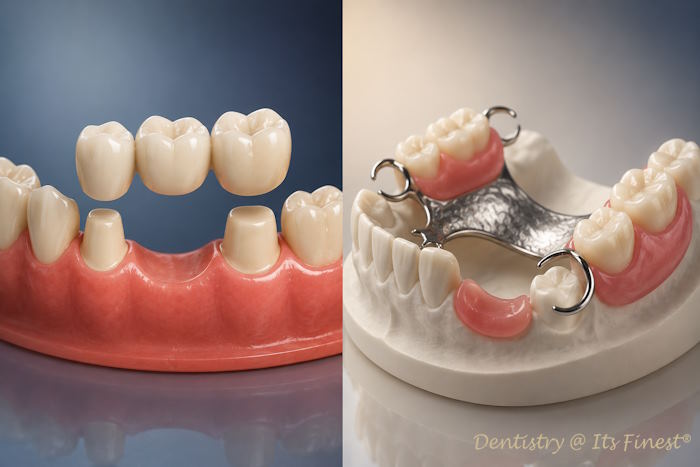
A dental bridge is cemented in. It doesn’t come out, you don’t clean it separately, and once it’s placed you largely stop thinking about it as a prosthetic. That permanence is the main thing people respond to when they hear about bridges.
The way it works mechanically: the teeth on both sides of the gap get prepared for crowns. Those prepared teeth, called abutments, anchor the entire restoration. The artificial tooth spanning the gap is called a pontic, and the whole thing, both crowns and the pontic, is fabricated as one connected unit and cemented at a single seating appointment.
Most bridges today are made from zirconia or porcelain fused to a zirconia substructure. Both materials are strong enough to handle the load of a back tooth and natural-looking enough that they’re not obvious to anyone who doesn’t know to look. A well-done bridge on healthy abutments can easily last 10 to 15 years, sometimes longer.
The catch is the abutment teeth. Those teeth have to be healthy, have solid root structure, and have enough intact tooth structure to support crown preparations. If the adjacent teeth are already heavily restored or crowned, a bridge can actually make clinical sense because those teeth are getting treated anyway. But if they’re perfectly healthy teeth with no existing restorations, preparing them just to hold a bridge is something worth thinking carefully about.
What a Partial Denture Is and How It Works Differently
A partial denture is removable. That single fact shapes everything else about the experience of having one.
The standard version is a cast metal framework, usually cobalt-chromium alloy, with acrylic gum-colored material and prosthetic teeth attached to it. Metal clasps grip your remaining natural teeth to hold it in during eating and speaking. At night it comes out. You brush it, soak it, and put it back in the morning.
Flexible partials, made from thermoplastic nylon rather than rigid metal, are an alternative that some patients prefer. They have no visible metal clasps, which matters a lot in areas of the mouth people can see. They flex slightly with movement rather than sitting rigidly, and some patients find them more comfortable to adapt to initially.
The real strength of a partial denture is its versatility. It can replace multiple missing teeth in different parts of the arch within a single appliance. If you’ve lost a molar on the upper right and a premolar on the lower left, a bridge can’t connect those. A partial can handle both with one piece. For more widespread tooth loss, that flexibility changes the equation significantly.
Who Typically Chooses a Dental Bridge or Partial Denture?
Most patients considering a dental bridge or partial denture are adults who have lost one or more teeth and want to restore their smile, chewing ability, and oral function. Bridges are often preferred by patients seeking a fixed solution, while partial dentures are commonly chosen by those looking for a more affordable and removable option.
The Key Differences Between a Bridge and a Partial Denture That Most Patients Want to Know
| Factor | Dental Bridge | Partial Denture |
|---|---|---|
| Fixed or removable | Cemented, does not come out | Removed daily for cleaning |
| Effect on adjacent teeth | Abutment teeth require crown preparation | No preparation of neighboring teeth |
| What it can replace | One to three consecutive missing teeth | Multiple teeth, including non-adjacent |
| How long it typically lasts | 10 to 15-plus years | 5 to 10 years before reline or replacement |
| Bone preservation | Does not prevent bone resorption under the pontic | Does not prevent bone loss either |
| Upfront cost | Generally higher | Generally lower |
That bone loss point is worth pausing on, because patients don’t always hear it clearly. After a tooth is extracted, the jawbone in that area begins to resorb because there’s no longer a root stimulating it. A bridge spans that space but does nothing to address what’s happening in the bone underneath. A partial denture rests on the gum tissue over that ridge and also does nothing to prevent bone loss. The only option that actually preserves bone long term is a dental implant, because the titanium post integrates into the jaw and provides direct stimulation the way a natural root does. If you haven’t discussed implants as a third option, it’s worth asking about before you commit to either a bridge or a partial.
If you haven’t considered implants as a third path, it’s worth asking about before committing to either option. For a fixed restoration, you can also see typical bridge pricing to compare against a partial.
“The bridge versus partial conversation always comes back to the same question: what does the rest of your mouth look like? If the teeth next to the gap are healthy and unrestored, preparing them for a bridge is a real tradeoff. If those same teeth already have large fillings or old crowns, the calculus changes completely. There’s no universal right answer, only the right answer for your specific situation.” — Michael Ayzin DDS
According to the American College of Prosthodontists, more than 178 million Americans are missing at least one tooth. Bridges and partial dentures together remain the most commonly used restorations for patients who still have some of their natural teeth.
How to Choose Between a Bridge and a Partial Denture Based on Your Specific Situation
If you’re replacing one or two teeth in a row and the adjacent teeth are already compromised or crowned, a bridge is probably the more straightforward path. It’s fixed, it functions naturally, and patients who go the bridge route tend to forget it’s even there after a few weeks.
If you’re dealing with multiple missing teeth scattered around the arch, or if the teeth next to the gap aren’t strong enough to serve as reliable abutments, a partial is more practical. It’s also the lower upfront investment, which matters when someone needs to phase treatment over time or isn’t in a position to do everything at once.
Some situations aren’t ready for either yet. Active gum disease, failing adjacent teeth, or significant bone loss all need to be addressed before any prosthetic work goes in. Getting that foundation stable first isn’t a delay, it’s what makes the restoration worth placing.
What doesn’t work is choosing based on which option sounds better in theory without an actual clinical assessment. The same tooth gap looks completely different on two different patients once you factor in bone levels, adjacent tooth health, opposing dentition, and how the bite loads across that area.
Patients Share Their Honest Experience
“My first visit far exceeded my expectations. I had not been to a dentist in at least a decade and bright and cheery it was compared to the old days. I got a deep cleaning and a temporary bridge for a missing tooth on my first visit. I’m 100% happy about the whole experience. The dentist and staff were great.”
— Bernard Shick
“I am so grateful and blessed that I found Dentistry At It’s Finest. I was tired of wearing uncomfortable and ill fitting dentures. I made an appointment and the process began that 1st visit. It was an incredible journey, one that was so rewarding and worth it. I love my new teeth and smile. The entire staff were so encouraging and an absolute pleasure to work with. I felt so comfortable in their care. Professional and genuine. If you’re looking for implants I give them a 10 and highly recommend them.”
— Joyce
Making the Decision
If you’ve been sitting on this choice, the most useful next step is a proper clinical evaluation, not more research. X-rays, a look at your bite, and an assessment of the teeth next to the gap will tell you more than any comparison chart.
Dentistry At Its Finest sees patients from across the area, including Mesa Verde, East Side Costa Mesa, and Huntington Beach. If you’re trying to figure out which tooth replacement option fits your mouth and your life, call (949) 239-0020 and set up a consultation.
Bridge Tooth Repair | Your Guide to Anesthesia for Wisdom Teeth Removal
