
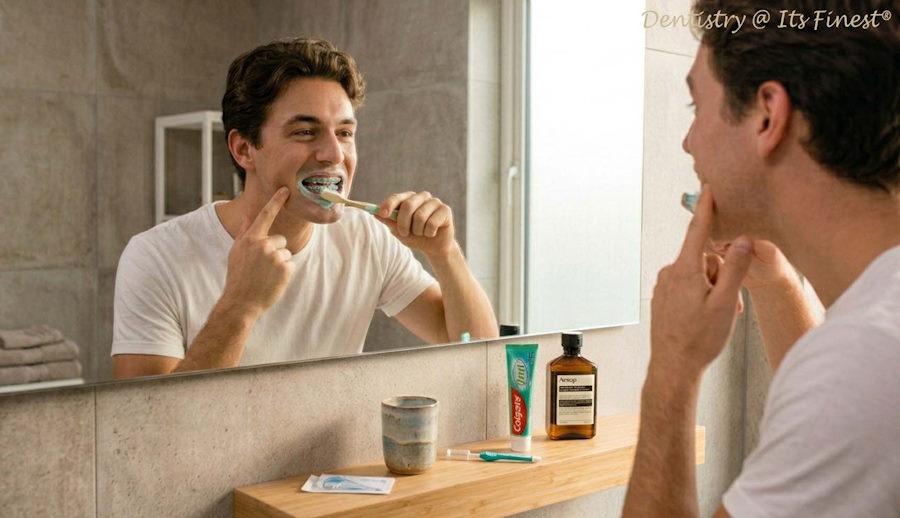
Brushing with braces is not the same activity as brushing without them. The hardware changes the geometry of every tooth surface, creates new spaces where plaque hides, and blocks the natural path of the toothbrush. Patients who keep using the same technique they had before treatment are, in most cases, not actually cleaning their teeth adequately, even if it feels like they are. Metal braces can fix complex bite issues with bracket and wire therapy, but maintaining proper brushing habits throughout treatment is essential for keeping teeth and gums healthy.
Dentistry At Its Finest goes over this with braces patients in Costa Mesa, CA, at every appointment, not just the first one, because technique tends to drift and the consequences accumulate quietly until they’re visible.
What Braces Actually Do to the Brushing Problem
Each bracket is a physical obstacle on the face of the tooth. It creates surfaces above it, below it, and on both sides that a brush moving in a normal stroke partially misses. The wire running across those brackets blocks the angle that most people use to clean near the gumline. The result is that plaque sits in the same spots every day, against enamel, without being disturbed.
Research in the Angle Orthodontist found that patients with fixed appliances accumulate significantly more plaque than patients without braces using identical brushing frequency and technique. The appliance is the variable. The technique has to compensate for it, or the outcome is predictable.
White spot lesions are what happen when it doesn’t compensate. These are permanent zones of enamel demineralization, the chalky opaque marks that appear on tooth surfaces around bracket margins after prolonged acid exposure from bacterial plaque. They form during treatment, and they stay after the braces come off. A patient who completes two years of orthodontic treatment with straight teeth and white spot lesions on every upper incisor has a legitimate grievance, and in most cases, it was preventable.
The Three-Zone Approach
The technique that works treats each bracket as dividing the tooth face into three distinct areas that each need separate attention.
The gumline zone sits between the wire and the gum tissue. This is the highest-priority area and the most commonly neglected. Position the brush at a 45-degree angle toward the gum, work the bristles into the junction between the gum and tooth, and use small circular strokes. The wire above creates a partial obstruction that makes this zone easy to skip. Don’t skip it.
The bracket zone is the bracket face itself and the wire running through it. Angle the brush downward from above the wire so the bristles press into the space between the wire and the bracket. Short strokes. The bristle tips need to get into that gap rather than sliding across the wire surface.
The area below the bracket toward the gum completes the sequence. Angle upward from below to clean the lower bracket face and the tooth surface between the bracket base and the gingival margin.
Then do the same thing on the next tooth.
“When a patient tells me they’re brushing twice a day and I can still see plaque sitting on the bracket face, it’s almost never about effort. It’s always technique. The brackets create angles that a normal brushing stroke misses completely. Once I show someone the three-zone approach, the difference at the next appointment is immediate.” Sona Bekmezian DDS
The inside surfaces of the teeth don’t have brackets, but still need attention. These lingual surfaces get neglected during braces treatment because patients focus almost entirely on the hardware side.
A thorough brushing session with braces takes three to four minutes minimum. Two minutes isn’t enough when every bracket requires individual attention. That’s not an exaggeration. Time yourself once, and you’ll see how quickly two minutes go before you’ve worked around every bracket properly.
Which Tools Actually Help
A soft manual brush works if the technique is correct and the time is there. An orthodontic brush with a V-shaped bristle configuration has a channel designed to straddle the wire and clean above and below it in one stroke. It doesn’t eliminate the need for the three-zone approach but it makes the wire zone easier.
Electric toothbrushes with oscillating heads produce better plaque removal than manual brushing across most patient populations according to Cochrane Database systematic reviews, and for braces patients, the continuous oscillation maintains cleaning action even when the angle isn’t perfect. That’s meaningful because a perfect angle across every bracket on every tooth is hard to maintain for four minutes.
| Tool | Where It Helps | What It Doesn’t Do |
| Soft manual brush | Full technique control | Requires consistent four-minute commitment |
| Orthodontic V-brush | Wire zone easier to access | Doesn’t eliminate three-zone technique |
| Oscillating electric brush | Compensates for imperfect angle | More expensive, needs charging |
| Interproximal brush | Under wire and bracket base | Doesn’t clean tooth surfaces or contacts |
Fluoride toothpaste is not optional here. The fluoride remineralizes enamel between acid attacks and strengthens the crystal structure against the demineralization process that produces white spot lesions. For patients showing early signs of demineralization, a prescription-strength fluoride rinse on top of regular toothpaste is worth discussing.
How Often
More than before braces. Twice daily was adequate without hardware. With brackets trapping food and debris against the tooth surface, the clinical guideline is to follow after every meal. Plaque begins interacting with bacteria and producing acids almost immediately after eating. A patient who eats lunch at noon and doesn’t brush until 10 pm has given that process eight hours to run against the enamel adjacent to their brackets.
The bedtime session is the most important one. Salivary flow drops during sleep, which means the natural buffering and cleaning action that saliva provides during the day disappears overnight. Whatever plaque is on the teeth at bedtime has uninterrupted contact with enamel for seven to eight hours.
When brushing after a meal isn’t possible, rinsing with water reduces debris and dilutes oral acids temporarily. It doesn’t replace brushing, but it’s better than nothing between meals.
Keeping Teeth Healthy Through Treatment
“I’ve been a patient with Dentistry @ It’s Finest for years, and I cannot express how caring the team here is. From routine cleanings and checkups to braces, and everything in between— this truly is the finest dentistry office I’ve been to.” – Eric Jensen
“I went in for a braces consultation a few days ago and have been meaning to get to review this place! I loved how nice and accommodating their staff was, the Dr. was very understanding of all of my concerns and tried to make sure I knew everything.” – Jazmin Carbajal
Sona Bekmezian DDS and the team at https://www.finestdentistry.com/ check brushing technique and monitor for early demineralization at appointments throughout treatment, not just at the start. Call (949) 239-0020 with questions about your current routine or to get started with a consultation.
Dentistry At Its Finest is proud to serve braces patients from neighborhoods including College Park, Mesa Del Mar, and Newport Beach. If you have questions about keeping your teeth clean during orthodontic treatment, our team is happy to help. Call us today at (949) 239-0020 to schedule an appointment with Dr. Bekmezian.
